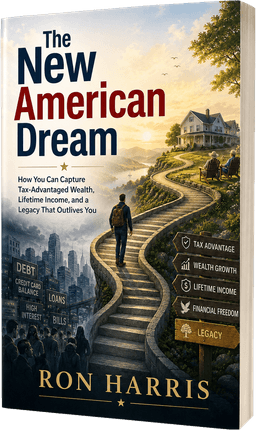
The New American Dream
Why I Wrote The New American Dream
Ron Harris on why he wrote The New American Dream: the structure problem behind working-family finances, the 2021 tax-code change that opened a door, and what the book promises.
By Ron Harris4 min read
The New American Dream is my new book, and it is now open for preorder in paperback, ebook and audiobook. This is the piece I would hand a reader who asks the fair question: another money book, why this one?
The rules were never explained to you
You did what you were told. You saved. You funded the 401(k). You made every payment on time. And you are still not getting ahead.
That is not an income problem and it is not a discipline problem. It is a structure problem. For over a century, banks and corporations have used a specific set of tools to build their balance sheets: cash-value life insurance, collateral, and spread. Working families were handed a thinner set. Same country, same tax code, two very different outcomes.
I sold the standard advice for years, first at Union Bank of California and then at Prudential. I believed it. Then I studied what those institutions did with their own money, and it did not match what they told customers to do with theirs. The largest banks in the country hold tens of billions of dollars in bank-owned life insurance. That is not an accident. It is the structure.
What changed, and why the book exists now
In December 2020, Congress passed the Consolidated Appropriations Act, 2021. Inside it was a quiet amendment to Section 7702 of the tax code, the section that decides how life insurance is taxed. The interest-rate assumptions in that section had been frozen since 1984. The amendment updated them, and from January 1, 2021, it became practical for an individual household to design a policy with the cash-value efficiency that only large institutions could reach before.
Almost nobody covered it. I spent the following years assembling the policy designs, the debt-optimization technology and the teaching that became Hybrid Financial Arbitrage: a plan that pairs a properly structured, privately owned life insurance policy with software that clears debt years early. The same dollars that now service your debt begin building an asset you own, control and can use while you are alive.
The New American Dream is the first complete, public treatment of that plan written for ordinary households. Thirty chapters, 266 pages, no prior financial training assumed.
What the book promises
Three outcomes, in this order.
- Own your home in five to seven years, on the budget you already have. The debt-optimization side of the plan routes the money already leaving your paycheck so the mortgage clears in years instead of decades.
- Retire on income you cannot outlive. Cash value inside the policy grows tax-deferred, and income comes out through policy loans that are not taxed as income. No required minimum distributions, no early-withdrawal penalties.
- Leave it all to your kids. The death benefit passes to named beneficiaries income-tax-free under Section 101(a). No probate, no income tax.
Nothing in the book is a loophole and nothing is a shortcut. The plan compounds over years and asks you to run your own finances instead of handing them to someone else. Chapter by chapter, the book is equally clear about what the plan costs and who should not use it.
Who I wrote it for, and who should skip it
Read it if you carry a mortgage, a car loan or credit-card balances and want them gone years early. Read it if you earn a working-, middle- or upper-middle-class income and the 401(k) alone does not feel like enough. Read it if you want retirement income you cannot outlive and something left to pass on.
Skip it if you want a fast win or a stock tip. Skip it if you need every dollar liquid in the short term. And skip it if you want someone else to run your money. The book teaches you to run your own.
How the book is built
The first chapters explain how banks really make money, and how the same mechanics work on a household balance sheet. Then comes the 2021 tax-code change in plain English, and how Hybrid Financial Arbitrage differs from Infinite Banking, Bank On Yourself, whole life and the 401(k). The middle of the book is the phase-by-phase path: debt elimination, then tax-advantaged lifetime income, then generational transfer. The closing chapters are the honest part: who the strategy fits and who it does not.
Where to get it
The paperback, ebook and audiobook are available for preorder from the retailers listed on the book page, and every edition ships or downloads on launch day. If you buy for a church, a company or a class, the bulk-order desk is on the contact page.
If you want to read before you buy, chapter one is free. It is the mortgage chapter: how a 30-year mortgage really works, why most families pay nearly the price of the house a second time in interest, and what a five-to-seven-year payoff looks like on the same budget. Leave your email on the free-chapter page and it goes out to your inbox.
Stop playing the bank's game on the bank's field. Build your own balance sheet. Capture your own spread.
Sources
- Consolidated Appropriations Act updates to Internal Revenue Code Section 7702 — American Council of Life Insurers
- IRC Section 7702 revisions resource page — Interstate Insurance Product Regulation Commission